What’s in a Name?
- Posted in:
- Heritage
- NewsletterArchive
This article comes from a 2003 NCC Heritage Newsletter:
Have you ever wondered where the name Eakring comes from? What about the village of Spion Kop? It should come as no surprise that the origin of many English place-names is a complicated one.
Although the study of place-names is a development of modern
scholarship, interest in the subject can be traced back as early as the 8th
century in England when the Venerable Bede (673-735 AD) included Latin
explanations of some of the place-names he mentions in his ‘Ecclesiastical
History of the English People’, completed in 731 AD.
The study of place-names is based on a patient and careful
collection of as many early spellings of a given name as possible. Even so, it
would be wrong to simply regard the study of place-names as the sole preserve
of linguists. Today, it owes much to the fields of social and economic history,
historical geography and archaeology.
Place-names of Celtic, and even pre-Celtic origin (some of which still survive), were already in use before the coming of the Anglo-Saxons in the second half of the 5th century. By the time of the Norman Conquest in 1066, the vast majority of our old place-names, whether of cities, towns, villages, parishes or even farms, were in existence. Because many of our place- names are so old it is necessary to trace the forms back to the earliest possible date and thereby the earliest spelling if we are to fully understand their meaning. Unfortunately, this is not as easy as it sounds. During this period, our shores suffered a multitude of foreign invasions, and therefore today’s place-names derive from a variety of languages including pre-British, British, Latin, Old English, Old Norse and Norman French. The situation is further complicated by the fact that comparatively few spellings from pre-conquest times have survived, mainly because of the loss of early documents.
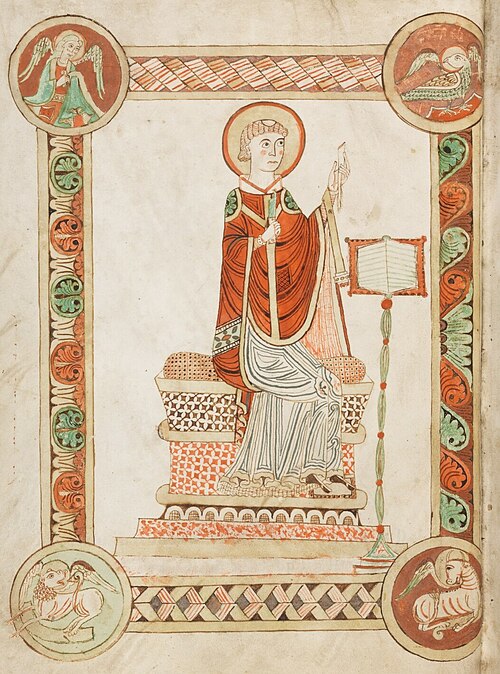
Above: Venerable Bede writing the Ecclesiastical History of the English People, from a 12th-century codex at Engelberg Abbey, Switzerland (by e.codices, Public Domain)
Place-names, whatever their origin, can be divided into two
principal types; habitative and topographical. The first type denotes inhabited
places such as farmsteads, enclosures or villages. These habitative place-names
can usually be split into two parts. In names of this type, the second element
usually describes the kind of habitation, while the first may be a descriptive
word. For example, Higham (‘high homestead’), or Woodborough (‘stronghold by
the wood’). In other forms, the first element may actually be a person’s name,
such as Ragnall (‘Ragni’s hill’), or the name of a tribe or group of people, as
is the case of Beckingham (‘the homestead of Becca’s people’).
The second type of place-names consisted originally of a description
of some topographic feature, such as a hill, wood or stream. Examples include
Blackburn (‘dark stream’) and Greenhill. More local examples included East and
West Leake which are situated on the banks of a small stream that joins the
River Soar at Kingston. In this case, both names derive from the old Norse word
‘loekr’. A further example is that of Eakring. The name here comes from a
compound of Old Norse ‘eik’ (oak) and ‘hringr’ (ring or circle), and may have
originally referred to a circle of oak trees.
Unlike the name Eakring, which as been with us for around a
thousand years, Spion Kop (near Warsop) is a relatively recent settlement which
takes its name from the 1900 battle of Spion Kop, which took place in South
Africa during the Second Boer War (1899-1902). ‘Kop’ is an Afrikaans word
meaning ‘look-out hill’ and is therefore c17th Dutch in origin.
It should come as no surprise that the name Eakring is Scandinavian in origin, as Notts was one of the earliest parts of England occupied by Viking invaders. Nottingham, along with Derby, Leicester, Stamford, and Lincoln, formed one of the Five Boroughs of the Danelaw, an area of England subject to Danish Law and recognised by King Alfred of Wessex who signed a treaty with Guthrum, leader of the Danes, in 886 AD. For those of you interested in discovering the Viking origins of some of Nottinghamshire’s place-names here are some of the most common Scandinavian elements used in English place-names.
|
Common modern
forms |
Meaning |
Source |
|
Bank, -bank,
Barrow-, Bar- |
Bank, ridge |
Old Danish,
banke |
|
Berg-, -ber,
-berry, -borough |
Hill, mound,
tumulus |
Old Norse,
berg |
|
Beck-, -beck |
Beck, stream |
Old Norse,
bekkr |
|
Booth,
-booth, -both |
Booth,
temporary shelter |
Old Danish, bôth Old Norse búðl |
|
Breck,
-breck, -brick |
Slope, hill |
Old Norse,
brekka |
|
-by |
Farmstead,
village |
Old Norse, by |
|
Carr, -carr,
-car, -ker |
Marsh, bog |
Old Norse,
kiarr |
|
Dale, dal-,
-dale |
Dale, valley |
Old Norse,
dair |
|
-ergh, -er |
Shieling,
hill-pasture |
Old Norse,
erg |
|
Gate, -gate |
Way, road,
street |
Old Norse,
gata |
|
Holme, -holme,
-holm, -ham |
Small island |
Old Norse,
holmr |
|
-how, -howe,
-hoe, -oe |
Hill, mound,
tumulus |
Old Norse,
haugr |
|
Hulme, -hulme |
Island, water
meadow |
Old Danish,
hulm |
|
Keld-, Kel-,
-keld |
Spring |
Old Norse,
kelda |
|
Lound, lund,
lunt, -land |
Grove, copse,
sacred grove |
Old Norse,
lundr |
|
Stain-,
stan-, sten- |
Stone |
Old Norse,
stein |
|
Thorpe |
Secondary
settlement or farm |
Old Danish, þviet |
|
Toft, -toft |
Meadow,
clearing |
Old Danish,
toft |
|
Wath, -wath,
-with, -worth |
Ford |
Old Norse, vað |