This fantastic article comes from our Spring 2000 Heritage Newsletter:

When King John died in Newark Castle in 1216, the cause was believed to have been his overindulgence in a favourite food – lampreys. He was not the only king to have enjoyed the dish, Henry I reputedly died of a ‘surfeit of lampreys’ in 1135. Lampreys were a Medieval delicacy. The ones on which John feasted will have come from the river Trent, one of the few places in the country where they could be caught in abundance. They remained a Nottinghamshire delicacy for centuries but are now little known.

The lamprey looks like an eel. Its mouth is a round sucker. It has one nostril on the top of its head, seven round gills on either side of its head, and a pair of eyes. The gills and nostril when viewed from the side look like eyes, hence the creature’s Nottinghamshire name of the ‘nine eyed lomper’.

Two species of lamprey may be found in the Trent, the river lamprey which grows to about 30cm long, and the brook lamprey, shorter at 15cm. The river lamprey is a parasite of freshwater fish on to which it hooks with its strong sucker-like mouth and ring of sharp teeth. It will also feed on carrion. The adult brook lamprey does not feed at all. Anglers rarely notice the fish because they are not often caught with rod and line. Traditionally, the lampreys were netted or caught in baskets during their spring migration up stream where they went to spawn and then die. The weir at Averham was a favourite place for catching the lampreys, and sometimes they may be spotted there, hanging on to stones with the suckers of their mouths, tails streaming like a ribbon in the current.

While the deaths of both kings were ascribed at the time to their excessive fondness for the fish, other reasons are possible. Henry I was 67 when he died, old by the standards of the time. Only a few days before John reached Newark, he suffered the disastrous loss of his baggage train whilst travelling across the Wash, and his death may be a consequence of this accident. However, the specific mention of lampreys suggests that both kings had been presented with the delicacy shortly before they died. Lampreys live in unpolluted water. Where they are taken from polluted rivers, they can carry harmful bacteria. Could the Medieval fishermen of Newark have prepared a treat for the king, only to inadvertently kill him with food poisoning?

Photograph of European river lampreys

Above: River lamprey (By Tiit Hunt - Own work, CC BY-SA 3.0).

Lampreys can be prepared in a number of different ways; stewed, potted, or baked into pies, but frying makes them tough and chewy. They may be treated as eels. Here is a recipe to try;

Lamprey Pie:

  • 1-2 Lampreys
  • 150g Lincolnshire sausage meat
  • Salt and Pepper
  • Packet puff pastry
  • Juice of a lemon
  • Parsley
  • Nutmeg
  • 1 shallot, finely chopped
  • 200ml Bechamel Sauce

Cut the lampreys into pieces 5cm long. Line an oven proof dish with half of the puff pastry. Cover the bottom of the dish with the sausage meat. Cover with the lampreys. Add a pinch of salt, pepper, a little nutmeg, the shallot, lemon juice and a good sprinkling of chopped fresh parsley. Cover the pie with the rest of the pastry and bake until the top has risen and pale golden. Remove from the oven and through the vent pour the Bechamel sauce. Return to the oven for 5-10 minutes. Serve immediately.

Whatever the truth behind the mystery of John’s death, this is certainly a dish fit for a king!

There are some wonderful heritage events scheduled for July, check some of them out below:

Throughout July: The D.H. Lawrence Museum is hosting ‘The Pentrich Revolution in Art’ exhibition throughout the month of July. ‘The Pentrich Revolution of 1817- England’s last armed rebellion. The story of the Derbyshire men who stood up to a repressive government demanding political rights and an end to enforced poverty. This hidden tale of Eastwood's connection to this pivotal moment in English history is told in visual interpretation boards and paintings by several local artists, and can be found within the Gallery Space at the D.H. Lawrence Birthplace Museum’. Visit the website here Throughout July: The D.H. Lawrence Museum is hosting ‘The Pentrich Revolution in Art’ exhibition throughout the month of July. ‘The Pentrich Revolution of 1817- England’s last armed rebellion. The story of the Derbyshire men who stood up to a repressive government demanding political rights and an end to enforced poverty. This hidden tale of Eastwood's connection to this pivotal moment in English history is told in visual interpretation boards and paintings by several local artists, and can be found within the Gallery Space at the D.H. Lawrence Birthplace Museum’. Visit the website here.

Tuesday 2nd July: At Clumber Park, ‘discover the history of the 18th century walled kitchen garden and see how the Gardens team continue to work this space using a variety of traditional horticultural methods’ by joining ‘Walled Kitchen Garden’ tour. No booking is required, and the event is free. For more information about how to join the tour, visit the website here.

Wednesday 3rd July: Thursday 25th July: The Workhouse and Infirmary in Southwell will be hosting a special ‘Written on the Workhouse Walls’ trail for the majority of July. ‘Find the bricks, solve the riddles and discover how vagrants used secret symbols to pass on messages in the 1800s’. Trails are £2 each and no booking is required. Visit the event information here.

Friday 19th July: Opening at the end of the month and running until January 2025, the University of Nottingham Museum will be hosting an exhibition titled ‘Bronze Age Offerings in the River Trent’.  ‘Around 3000 years ago, the rich warriors of the East Midlands made offerings in the River Trent, and about 200 of these bronze objects have been recovered from the river, making it one of the biggest such collections in Europe’. No booking required and admission is free. For more information about the exhibition, visit the event page here. Check out some of our HER records of the finds: Colwick, Stoke Bardolph/Shelford, Wilford Bridge, Bleasby and Trent Bridge

Above: River Trent and Trent Bridge, West Bridgford. (By Insignia3, CC BY-SA 3.0)

Saturday 20th July: Head down to the National Civil War Centre in Newark for a festival of archaeology! ‘Meet Catherine and Richard, The Field Detectives, and discover how community archaeologists find traces of the past in the most unlikely places! Chat to them throughout the day and enjoy an interactive look at the materials and practice of history in the field’. Handle real artefacts, look at the tools of treasure-hunting, and much more. No booking is required, just drop in. Visit the event page for more information.

Sunday 21st July: Join Alison Milbank, Professor of Literature and Theology at the University of Nottingham, for a lecture focusing on Lancelot Andrewes at Southwell Minster. Lancelot was a bishop and scholar active during the reigns of Elizbeth I and James I. No need to book, just drop in. To find out more about the lecture, visit the event page here.

Thursday 25th July: Wollaton Hall will be hosting a special performance of open-air theatre. ‘This summer, Three Inch Fools present a brand-new comedy of their own about one of England’s most epic monarchs, Henry VIII’. Tickets cost £20 (adults) or £12 (Children aged 5-16), family tickets (2 adults, 2 children) costs £55. To book your tickets, visit the event page here.

Saturday 27th July: ‘Come and find out about recent archaeological work at Southwell Roman Villa with the Southwell Community Archaeology Group’ during a special workshop at the University of Nottingham Museum. ‘In this free drop-in workshop, you’ll have the opportunity to handle archaeological artefacts. You can also explore Roman frescos. Find out how the Romans made their paint pigments and have a go at creating your own design using stencils’. The workshop is free, and no booking is required. For more information, visit the event page here.

This inspiring article comes from our Winter 2009/2010 Newsletter:

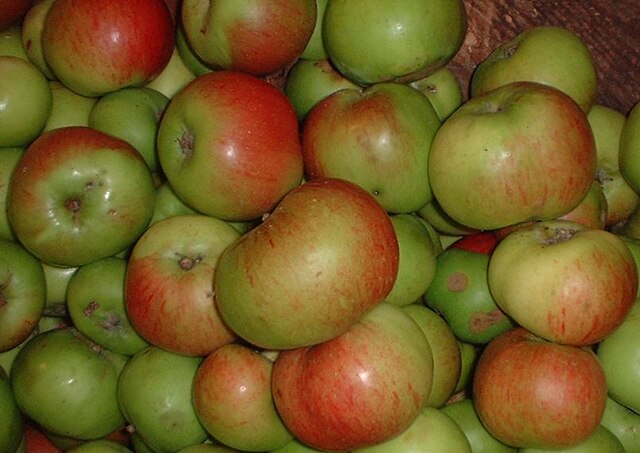
The Bramley Apple story begins around 1809 with Mary Ann Brailsford, a young Southwellian who took some pips from the apples her mother was preparing and planted them in a flowerpot. As one of the pips was doing so well, it was later transferred to the young girl’s garden where it began to thrive. It is this tree that first began to bare a unique apple, one that has become the most respected apples in the world. Sadly, however, Mary left the family house and her apple seedling, and later died, without knowing how influential her seedling would become in the future.

Photograph of two Bramley apples

Above: Bramley Apples (By Marcin Floryan - Self-photographed, CC BY-SA 2.5)

The apple that has become one of Southwell’s most celebrated assets may have gone unnoticed if it had not been for a certain young Henry Merryweather who was born in Carlton-on-Trent in 1839. His father, also called Henry, had been in the employment of Reverend John Drake Becher as a gardener in Carlton-on-Trent until 1840, when the Reverend moved to take up residence at Norwood Hall in Southwell, taking his gardener with him to look after the extensive gardens which supplied the needs of the house.

Henry Jnr joined his father working in the gardens of Norwood Hall at the tender age of 10, allowing him to gain a first-class knowledge of horticulture and develop a particular interest in the may different fruits which were grown in the grounds and walled kitchen garden.

In 1854, father and son ceased working at Norwood Hall so that they could begin their own business as nurserymen. They invested in buying two acres of land (adjacent to Norwood Park) which was just sufficient for the Merryweathers to concentrate on cultivating and selling fruit, strawberries in particular.

It was purely by chance that one day, young Henry Jnr noticed some fine-looking apples that the gardener of the Vicar Choral of Southwell Minister was carrying in a basket. Upon asking the gardener where he had got the apples from, the gardener replied that they were off the tree that grew in Mr Bramley’s garden at No. 73, Easthorpe. Henry immediately went round to see Mr Bramley to ask if he could take some grafts from the apple tree, so that he might propagate it for he believed he had found a unique apple.

Mr Bramley was happy to oblige and said that Henry could take as many grafts as he wished, as long as he named the apple that they produced after him. Henry was extremely successful in cultivating the grafts and was soon producing an award-winning apple.

Image of Bramley Apple sapplings

Above: 'Painted by John Ralph Starkey at Norwood in 1910', some Bramley seedlings planted by Mr Starkey at Norwood Hall park at the start of the 20th century (By PresstheStarKey - Own work, CC BY-SA 4.0). You can find out more about the Starkey saplings at Norwood Park and even possibly buy a Bramley sapling clone here.

Henry Merryweather first presented the ‘Bramley Seedling’ to the Royal Horticultural Society’s Fruit Committee on the 6th December 1876 where it was highly commended. On presenting the variety again in 1877, the apple received a First-Class Certificate by the Committee of the Royal Jubilee Exhibition of Apples in Manchester.

Since those early years, the Bramley Apple has received several first-class certificates and is now recognised as one of Britain’s best loved varieties. Many celebrations of the apple are hosted in Southwell to this day including the Bramley Apple Food and Drink Festival hosted by Southwell Minster in October.

Our wonderful libraries and heritage attractions in Nottinghamshire are hosting a multitude of events to keep you occupied this June. Check some of them out below:

Saturday 1st June: Head to Bassetlaw Museum with your historical or archaeological items to be identified and recorded by our fantastic Finds Liaison Officer for Derbyshire and Nottinghamshire. This event is free, but booking is required. Book your appointment here.

Wednesday 5th June: Launching on Wednesday is a 5-week beginners’ course on family history which will introduce you to the main types of records available for your research. You will discover where to locate family history documents and online information, as well as developing your research skills to help you make sense of what you find. The course costs £36 and sessions will take place at the Retford Library. For more course information and booking details, visit the event page here.

Saturday 8th June: Join King Henry VIII at Southwell Minster for a lively evening where His Majesty will recount the events of his long reign; telling of his wives and his children and will invite you to petition him or question him on any related subject. Tickets cost £17.61 per person and are available online here or through the Cathedral shop (in person or 01636 812933).

Saturday 8th and Sunday 9th June: Sherwood Forest is hosting an amazing War of the Roses re-enactment weekend. Re-enactment groups from both sides will set up their camps across the events green giving you the opportunity to get up close and personal to some real-life living history. There will be medieval cooking, weaving, spinning and armour and weapons on display. Also, with a range of talks, shows and skirmishes available throughout the day, you will be sure to be properly entertained. This event is free admission, but activities vary. For the event itinerary and more information, visit the event page here.

Saturday 15th and Sunday 16th June: Come and see a historical re-enactment of Georgian and Victorian bare knuckle prize fighting and learn all about the sport at the Southwell Workhouse and Infirmary. This event is free (admission to the site still applies) and booking is not required. Visit here for the event information.

Photograph of Southwell Workhouse

Above: Southwell Workhouse.

Tuesday 18th June: Archaeologist and author James Wright will be speaking about his new book Historic Building Myth-busting at Mansfield Central Library. Secret passages linking ancient buildings, spiral staircases giving advantage to right-handed defenders, ship timbers used for building, or blocked doors in churches to keep out the devil, James will explain the development of such myths and the underlying truths behind them. Tickets are £3 per person. Book your place here.

Wednesday 19th June: Join one of the Inspire librarians for a small group session to talk about the history of Nottinghamshire's parish registers and look at some of the fascinating stories they contain at Worksop Library. This event is free. Book your place here.

Wednesday 19th June: Djanogly Gallery, part of the University of Nottingham, is hosting a wonderful talk called ‘Cultural Nexus: Engaging Community through Museums, Archives, Curation, and Repatriation’. The presentation centres on the work of Roshan Mishra (Director of Taragaon Next and a Kathmandu-based visual artist) in the field of museums, archives, curation, and repatriation in Nepal. It examines the importance of these activities, their impact, and community engagement. Roshan will illuminate the dynamic ways these cultural pillars intertwine, fostering understanding, preservation, and a shared connection to our diverse heritage. This talk is free and can also be viewed online. Book your place here.

Thursday 27th June: To mark the 200th anniversary of Byron’s death, the University of Nottingham is providing a lecture on different elements of his life and work. This lecture will include several speakers will present different viewpoints and perspectives on the life and legacy of Lord Byron, followed by a question-and-answer session. Tickets cost £3 per person. Book your place here.

Portrait of Lord Byron

Above: Portrait of Lord Byron. By Thomas Phillips - BBC Your Paintings, Public Domain. 

This wonderful addition comes from our Summer 2009 Newsletter:

‘Three wise men of Gotham

Went to sea in a bowl;

And if the bowl had been stronger,

My song would have been longer’

History:

Around the year 1540, an amusing collection of twenty stories were published entitled ‘Certaine Merry Tales of the Mad Men of Gotham’. This book was written by the mysterious ‘A.B. of Phisicke Doctor’.

The pseudonym A.B. was supposed to represent Andrew Borde, an eminent physician and writer who among other things was famous for his wit. In all probability, this was merely a play by the publishers to make people believe that Borde was indeed the author. Interestingly, Borde never denied involvement in the publication.

In subsequent editions, the word ‘mad’ was changed for ‘wise’ and the tales were born.

Although The Wise Men of Gotham is a collection of stories compiled into a single work, it is highly likely that the tales were not the work of one single author, and that many of the stories, perhaps all, existed before 1540. The wise fools of Gotham are first mentioned in the fifteenth century. They appear in the ‘Towneley Mystery Plays’, and one of the later published tales makes an appearance in a manuscript entitled ‘The Wickirk Play’, written between 1425 and 1450.

The Wise Men of Gotham was such a popular publication that the work continued to be re-published almost unchanged up to the end of the nineteenth century. The tales were even exported to America by Washington Irvine who then bestowed the title of ‘Gotham City’ (a city of fools) on his native New York. This in turn turned developed into the Gotham City of Batman.

Cartoon image of the Gotham Fools

Above: William Wallace Denslow's illustrations for Three Wise Men of Gotham, from a 1901 edition of Mother Goose. Image: Public Domain.

The tales:

There are two popular versions of the tale. In the first, King John was making his way north towards Nottingham. His chosen route would have taken him directly through land owned by the village of Gotham. At that time, it was believed that wherever the king walked, was from that day a royal highway, with public rights of way. Therefore, to avoid the expense of paying for the upkeep of the new King’s Highway, when King John’s heralds arrived in the village, the good folk of Gotham feigned madness. As madness was thought to be contagious, when this news reached the ears of the King, he quickly changed direction to avoid the village of ‘mad men’.

The second version of the story states that King John was actually considering building a hunting lodge near Gotham. In order to prevent the loss of pasture land and the expense of supporting the royal court, the story continues in the same manner as the first, with the result that the King changes his plans and builds his lodge elsewhere.

There is not enough room here to tell all of the twenty stories of the wise men of Gothams’ strange behaviour, but here is our favourite:

The Cheeses That Ran Away…

There was a man of Gotham who filled a sack with cheeses to sell at the market in Nottingham. He carried the sack of his back, and when he became tired he paused along the way to rest.

Eventually he reached the summit of the last hill before he came to Nottingham Bridge. There he rested, and when he rose to continue his journey, a cheese slipped out of the sack and rolled down the hill towards the bridge.

‘Ah! Mr Cheese,’ said the man, ‘so you can run to market alone, can you? I wish I had known that before. It would have saved me the trouble of carrying you. Well, then, if you can go to market alone, so can the other cheeses, and I’ll send them along after you.’ So, he laid down his sack, took out the cheeses, and rolled them all down the hill. As the last one spun down the road, he shouted, ‘I charge you all to meet me at the market-place.’

Some of the cheeses went into one bush, and some went into another bush, but the man did not notice that, and he trudged on cheerfully to the market expecting the cheeses would meet him there.

All day long he loitered about the market. As evening approached, he began to inquire among the other traders if they had seen his cheeses come to the market.

‘Who should bring them?’ asked one of the traders.

‘Nobody,’ replied the man of Gotham, ‘They would bring themselves. They know the way well enough.’

‘Why, then, aren’t they here?’ said the marketman.

‘A plague on them all!’, cried the owner of the cheeses, ‘It has just occurred to me what the trouble is. I did fear, when I saw them start off so fast, that they would run beyond the market, and I’m sure they must now be miles away on the road to York.’ This said, he hired a horse and rode in all haste to York in pursuit of his cheeses.

Photograph of the Gotham village legend wind vane

Above: Gotham Legends wind vane. Image: By John Beniston - Own work, CC BY-SA 4.0

Which Gotham?

The tales Wise Men of Gotham has long been associated with the Gotham of Nottinghamshire. However, there is another Gotham, in Sussex, that also lays claim to the tales. Fortunately, the Sussex Gotham was never a village or even a hamlet. In actuality, it was only a manor in the parish of Hailsham, a fact that any local writer would have been well aware of. Also, early editions of the book actually mention Nottingham market and that the village was on a direct route to York. Furthermore, it clearly states in one of the stories that the villages paid rent to the lordships of Leicester and Chester which is a known historical fact of the Nottinghamshire village.

Nevertheless, it seems that Gotham only became the ‘best known’ village of fools because of the published tales. There are at least 45 other villages in Britain that claim as their own one or more of the Gotham tales. Gotham is unique in that it not only preserves a complete collection of tales but also preserves many of the locations of the stories.